You’ve got a professional website showcasing your services, previous work and everything customers need to know about your business. But there’s one important question: how do you get people to actually find it?
When someone needs a plumber, electrician, builder or landscaper, Google is often one of the first places they look.
Getting your website to appear in those searches is where search engine optimisation (SEO) comes in.
The good news is that you don’t need to understand all the technical details to recognise what makes a difference. Here are the main things worth focusing on.
1. Understand what your customers are searching for
Before worrying about Google rankings, think about what someone would actually type into Google when looking for your services.
For example, an electrician in Oldham might want to appear for searches such as:
- Electrician in Oldham
- House rewiring Oldham
- Fuse box replacement Oldham
- Electrical inspection near me
These searches tell you something important. People aren’t always looking for a general tradesperson. They’re often searching for someone who can carry out a particular job.
That’s why it’s worth identifying the services you most want to promote and the locations where you want to attract customers.
Quick tip: Think about the questions customers ask when they call you. These can provide useful ideas for the information people might be searching for online.
2. Give your main services their own pages
We covered the importance of individual service pages in our previous guide, but they’re also an important part of getting found on Google.
Imagine a bathroom fitter offering complete bathroom renovations, mobility bathrooms and wet room installations.
Rather than squeezing everything onto one page, creating dedicated pages gives each service room to be explained properly.
These pages should include:
- A clear heading explaining the service.
- Helpful information about what’s involved.
- Photographs of relevant completed work.
- Answers to common customer questions.
- A clear way to request a quote.
This helps customers find the information they need and gives Google a better understanding of the individual services your business offers.
Remember, the aim isn’t to repeat the same keywords throughout the page. It’s to create genuinely useful content about the work you carry out.
3. Make sure Google knows where you work
For most tradespeople, attracting customers in the right locations is just as important as promoting the right services.
If you’re a landscaper based in Bury but regularly work in Bolton, Ramsbottom and surrounding areas, your website should make that clear.
Start by mentioning your main service areas naturally throughout your website, particularly on your homepage, contact page and relevant service pages.
If certain towns are particularly important to your business, you could also consider creating dedicated location pages.
However, these pages need to provide something useful. Simply copying the same text and changing the town name isn’t a good long-term strategy.
Instead, consider including:
- Services you provide in that location.
- Photographs of projects completed nearby.
- Customer reviews from the area.
- Useful information about the types of work you undertake locally.
Quick tip: Focus on areas where you genuinely want more work. There’s little point attracting enquiries from locations that are too far away or make jobs less profitable.
4. Set up and optimise your Google Business Profile
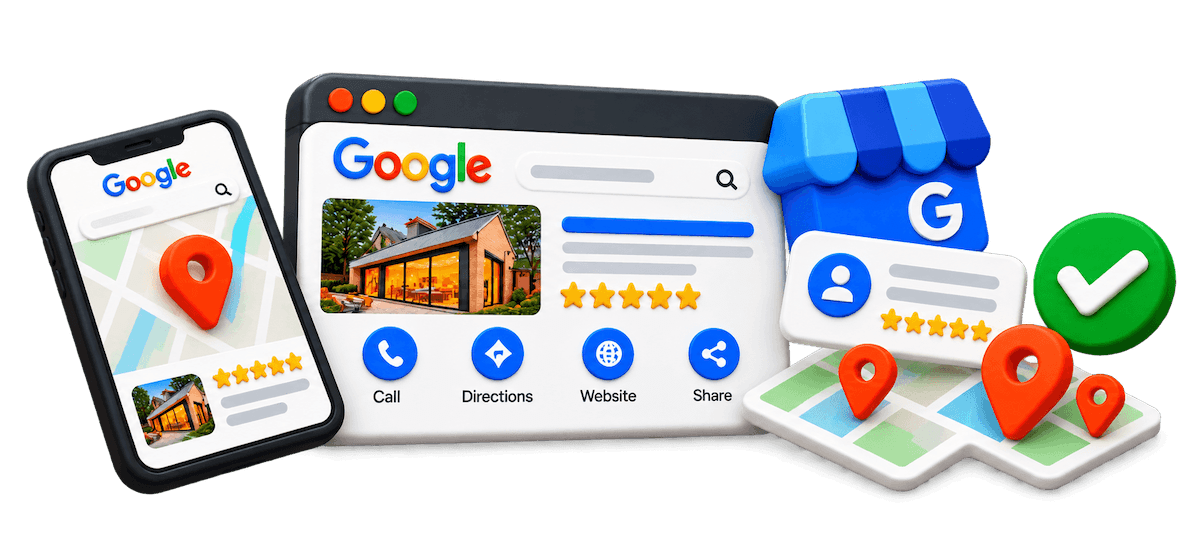
Have you noticed how Google sometimes displays a map with local businesses when you search for a tradesperson?
These results are closely connected to Google Business Profiles.
A Google Business Profile is free and allows eligible businesses to manage information such as their services, contact details, opening hours and customer reviews.
To make the most of yours:
- Use your genuine business name and accurate contact details.
- Choose the most relevant business category.
- Add your main services and the areas you cover.
- Upload photographs of your work regularly.
- Encourage genuine customers to leave reviews.
- Keep your information accurate and up to date.
If you work from home and travel to customers, you may be able to set up your profile as a service-area business without displaying your home address.
Your Google Business Profile and website should support each other, giving potential customers consistent information about your business.
5. Show Google and customers that you’re trustworthy
Google wants to provide useful, reliable results. Customers want to choose tradespeople they can trust.
Fortunately, many of the things that help build customer confidence can also contribute to a stronger online presence.
Think about what makes your business credible:
- Customer reviews: Genuine feedback from people you’ve worked for.
- Completed projects: Photographs and case studies demonstrating your experience.
- Qualifications: Relevant accreditations, certifications and professional memberships.
- Helpful information: Clear explanations of your services and answers to common questions.
- Business consistency: Accurate contact information across your website and other online listings.
It’s also worth understanding the role of backlinks. These are links from other websites to yours.
For example, a link from a relevant trade association, supplier or local business website can help people discover your business and may contribute to your website’s authority in search engines.
Focus on earning relevant, genuine links rather than buying large quantities of low-quality links.

6. Make sure your website works properly
Even the best-written website can struggle if it’s slow, difficult to navigate or doesn’t work properly on mobile phones.
Many customers will find your business while browsing on their phones, so the experience needs to be straightforward.
Some basic things worth checking include:
- Does your website load quickly?
- Is the text easy to read on a mobile phone?
- Can visitors easily find your services?
- Are your telephone number and contact buttons easy to use?
- Do all your pages and enquiry forms work correctly?
Your website should also be secure, with an SSL certificate, and its important pages should be accessible to search engines.
You don’t necessarily need to understand how to fix every technical issue yourself, but it’s worth making sure whoever manages your website keeps these things in good order.
7. Keep building your website over time
One of the biggest misconceptions about SEO is that it’s something you do once when your website launches.
In reality, improving your visibility on Google is usually an ongoing process.
As your business grows, there are plenty of opportunities to strengthen your website:
- Add new pages for important services.
- Publish case studies showing completed projects.
- Create helpful articles answering customer questions.
- Introduce relevant location pages.
- Collect new customer reviews.
- Update existing pages with fresh photographs and information.
For example, a roofing company could publish an article explaining the signs that a roof needs replacing, then link readers to its roof replacement service page.
This provides useful information for potential customers while helping build a more comprehensive website around the services the business offers.
8. Be patient and focus on the right results
SEO isn’t an overnight solution. Depending on your competition, location and the current state of your website, meaningful improvements can take time.
It’s also important to remember that appearing at the top of Google isn’t the only measure of success.
A website attracting hundreds of visitors who aren’t interested in your services may be less valuable than one attracting a smaller number of people who are ready to request a quote.
Rather than focusing entirely on rankings, pay attention to:
- Whether you’re attracting enquiries for the services you want.
- Which pages generate the most interest.
- Whether enquiries come from the locations you’re targeting.
- How your website’s visibility and enquiries develop over time.
The goal isn’t simply to get more website visitors. It’s to attract the right people and turn that interest into genuine business opportunities.
Final thoughts: Getting found is just the beginning
Getting your trade website found on Google starts with understanding your customers, promoting the right services and making it clear where you work.
Combine that with a well-built website, genuine customer reviews, useful content and ongoing improvements, and you’ll have a stronger foundation for attracting enquiries through search engines.
You don’t have to do everything at once. Start with the services and locations that matter most to your business, then build on those foundations as you grow.
Of course, getting someone onto your website is only half the challenge. You also need to give them a reason to choose you.
In our next guide, How to turn website visitors into enquiries, we’ll look at the things that encourage potential customers to get in touch rather than leave and visit a competitor.