So what makes a really good website for a trades business?
A good trade website should do more than look professional. It should help potential customers understand what you do, give them confidence in your business and make it easy to get in touch.
Whether you’re a self-employed electrician, a local plumber or an established building company, your website has an important job to do.
But not every trade business needs the same website.
A sole trader who gets most of their work through recommendations will have different requirements from a bathroom fitting company looking to attract customers across several towns.
That’s why, when we plan a website, we don’t start by discussing colours, layouts or how many pages it should have. We start by understanding the business, its customers and what the website needs to achieve.
In this guide, we’ll explain the thinking behind that process so you can make better decisions when planning your own trade website.
1. Start with what your website needs to achieve
The first question we’d ask is simple: What do you actually want your website to do for your business?
It might sound obvious, but the answer can make a big difference to how your website should be planned.
Let’s take two plumbing businesses as an example.
The first is a self-employed plumber who gets most of their work through word of mouth. They’re already busy but want a professional website that customers can visit to check their services, read reviews and find their contact details.
For that business, a relatively small website could do the job perfectly well.
The second is an established plumbing company with several engineers. They want to attract new customers through Google, promote boiler installations and bathroom renovations, and expand into neighbouring towns.
That business needs a different approach. Its website will need to support multiple services, target relevant searches and provide enough information to turn visitors into enquiries.
Neither approach is necessarily better than the other. They’re simply designed to achieve different things.
This is why we always recommend identifying your main objective before deciding what your website should include.
Are you looking to establish a professional online presence, generate more enquiries, promote particular services or expand into new areas?
You might want to achieve several of these things, but knowing your priorities gives the entire project a clearer direction.
2. Think about what your customers are looking for
Once we understand what you want from your website, the next step is to look at things from your customer’s perspective.
Why would someone visit your website, and what would they need to see before contacting you?
This is particularly important for trades because customers don’t all make decisions in the same way.
Imagine someone discovers a leaking pipe late in the evening. They’re probably looking for a plumber who covers their area, can respond quickly and has a telephone number that’s easy to find.
They’re unlikely to spend twenty minutes reading about the company’s history.
Now consider someone planning a £20,000 bathroom renovation.
They’re making a much bigger financial commitment, so their decision is likely to take longer. They’ll want to explore previous projects, understand the services available, read customer reviews and feel confident that the company can deliver the standard of work they’re expecting.
Both customers are looking for a tradesperson, but their expectations are very different.
This is something we consider when planning websites because it influences how information should be presented.
For businesses offering emergency services, quick access to contact details may be especially important. For trades specialising in larger projects, photographs, case studies and detailed service information can play a much bigger role.
Think about the customers you most want to attract. What questions do they usually ask? What concerns do they have? What helps them decide whether you’re the right person for the job?
Your website should be designed to answer those questions.
3. Make it easy for customers to understand and trust your business
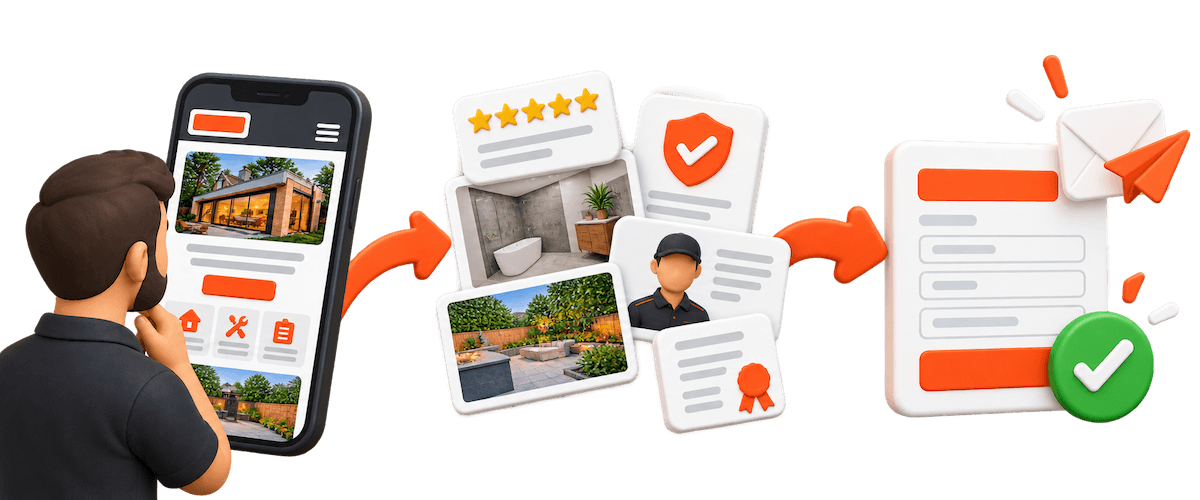
When someone visits your website for the first time, they shouldn’t have to work hard to understand what you offer.
Within a few moments, they should be able to answer three important questions:
Can you do the job? Do you cover my area? Can I trust you?
Let’s imagine you’re a homeowner looking for an electrician to replace an old fuse box.
You visit a website with an impressive design, but the homepage simply says “Professional Electrical Solutions”. There’s no obvious mention of fuse box replacements, the areas covered aren’t clear and you can’t find any examples of previous work.
You might move on to another electrician.
Now imagine visiting a website that clearly explains its electrical services, identifies the towns it covers and displays genuine photographs, customer reviews and relevant accreditations.
You immediately have a better understanding of the business and whether it can help.
That’s the difference between a website that simply looks good and one that’s been planned around its customers.
Of course, professional design still matters. A poorly presented website can create a negative impression, even when the business behind it does excellent work.
But good design should support the information rather than distract from it.
For most trade businesses, we’d recommend making your services and coverage areas clear, using genuine photographs wherever possible and giving customers straightforward ways to contact you.
Reviews, qualifications and examples of completed projects can then provide the reassurance people need before making an enquiry.
You don’t necessarily need every feature imaginable. You need the right information, presented clearly, so customers feel comfortable taking the next step.
4. Plan for the business you want to become
One of the biggest mistakes you can make when planning a website is thinking only about what your business needs today.
That doesn’t mean you should spend thousands building pages and features you won’t use. It means considering where you want the business to go and making sure your website can support those plans.
Let’s take a roofing company that’s just starting out.
Initially, it might only need a homepage, an overview of its roofing services, some photographs of completed work and a contact page.
That could be a perfectly sensible starting point.
But what happens when the company starts offering flat roofing, roof repairs, guttering and full roof replacements across several towns?
As the business grows, its website may benefit from dedicated pages explaining each service, detailed case studies and useful content relevant to the locations it serves.
If the original website was planned with future expansion in mind, adding those pages should be relatively straightforward.
The same applies to an established trade business looking to grow.
A bathroom fitter might want to become better known for mobility bathrooms. A builder might want to attract more extension projects rather than smaller repair jobs.
Understanding those ambitions early helps us plan a website that supports the type of work the business wants to win.
Our advice is to start with what you need, but build with the future in mind.
You don’t need a huge website from day one. You need a strong foundation that can develop alongside your business.
So, what does your trade website actually need?
A good trade website isn’t measured by how many pages it has, how expensive it was to build or how impressive the design looks.
It’s measured by how effectively it supports your business and helps customers take the next step.
Before planning your website, try answering these four questions:
- What do I want my website to achieve? Is it primarily about credibility, enquiries or business growth?
- Who are my ideal customers? What services are they looking for, and what matters most when choosing a tradesperson?
- What would convince them to contact me? Think about the information, photographs, reviews and reassurance they might need.
- Where do I want my business to be in the next couple of years? Are there services, locations or types of work you’d like to focus on?
You don’t need to have every detail worked out, but answering these questions will give you a much clearer starting point.
And once you understand what your website needs to achieve, the next step is deciding how to structure it.
Next article: What pages should a trade website have?
We’ll look at the essential pages most trade businesses should consider, when individual service pages make sense and how to organise your website so customers can find what they’re looking for.